


Radiology Oncology Systems is dedicated not only to providing reliable, cost-effective medical equipment to hospitals…
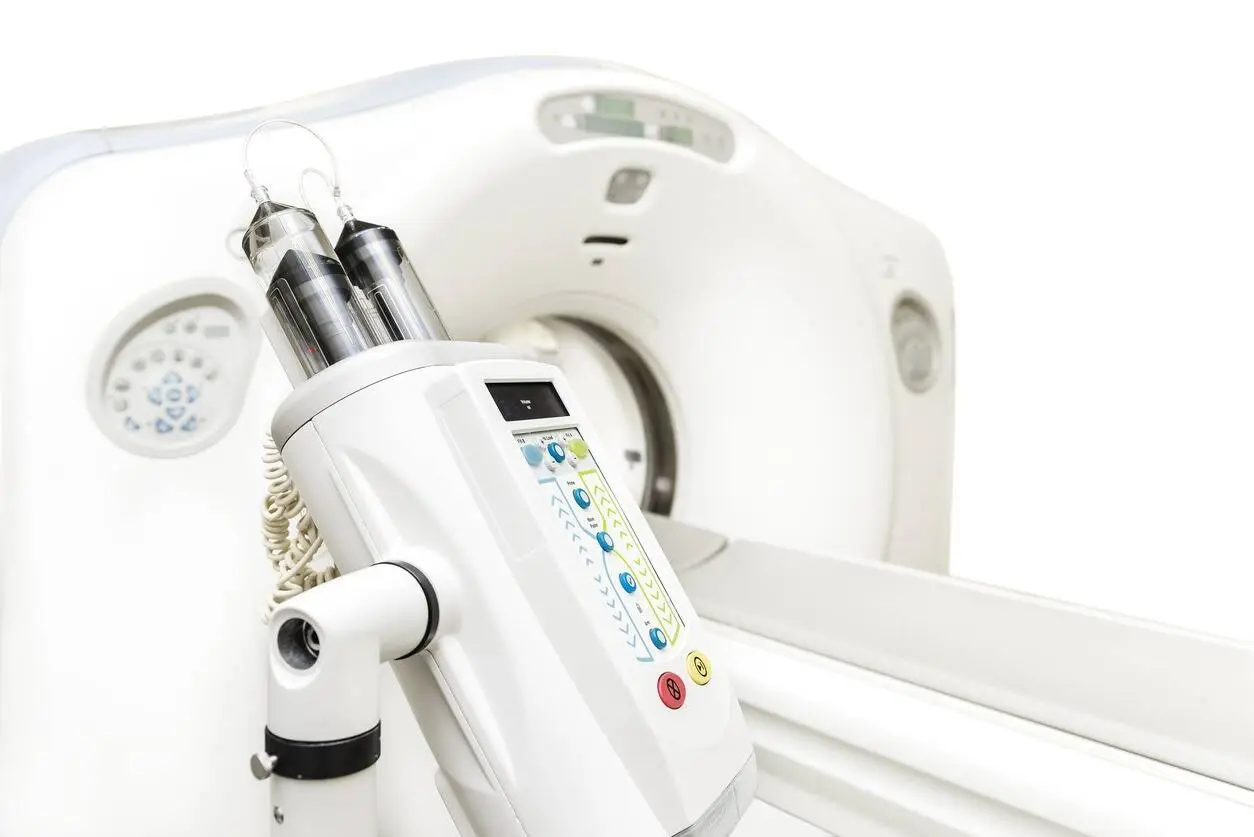
Contrast Injectors in CT, MRI, and Cath Lab/IR: Applications, Benefits, and Servicing Support
Medical imaging plays a vital role in diagnosing patients. A key part of many CT, MRI, and Cath Lab/Interventional Radiology (IR) procedures is the contrast injector, which ensures contrast is delivered with precision and consistency. These devices administer contrast media into a patient’s bloodstream at a controlled rate and volume. By automating this process, they provide consistent results and support safer, more efficient imaging.
The Role of Contrast Injectors in Diagnostic Imaging
In imaging, bones appear clearly on an X-ray because they absorb more radiation than soft tissue. Blood vessels, on the other hand, usually do not show up because they allow X-rays to pass through. A contrast injector solves this by delivering a contrast agent, a specialized fluid that helps blood vessels and soft tissues absorb X-rays or respond to magnetic fields. This makes them visible during CT, MRI, and Cath Lab/IR procedures, giving physicians a clearer look at internal structures and improving diagnostic accuracy.
Types of Contrast Injectors
There are three main types of contrast injectors: CT, MRI, and Cath Lab/IR. While all serve the same purpose, each is designed for its specific imaging environment.
- CT injectors deliver contrast during CT scans and are designed to handle flow rates of up to about 10 mL per second, with pressure limits around 300 PSI.
- MRI injectors function similarly but are made from non-ferrous materials so they can safely operate in the magnetic field of an MRI suite.
- Cath Lab/IR injectors are used in Cath Labs and Interventional Radiology rooms, where much higher flow rates, up to 40 to 50 mL per second, and pressures over 1,000 PSI are required.
Despite these differences, all contrast injectors share the same goal: delivering contrast media safely, consistently, and efficiently to produce high-quality diagnostic images.
Clinical Benefits of Contrast Injectors
In clinical practice, contrast injectors help CT, MRI, and Cath Lab/IR studies show more diagnostic detail than non-contrast imaging. This enables:
- Clearer visualization – Contrast highlights blood vessels, organs, and soft tissues for more detailed images.
- More accurate diagnoses – Enhanced clarity helps physicians detect tumors, blockages, and other conditions with confidence.
- Advanced functional imaging – Timed injections allow evaluation of blood flow and organ performance, not just anatomy.
- Consistency and efficiency – Automated delivery reduces variability between scans and streamlines technologist workflow.
With their impact on image quality and workflow, ensuring contrast injectors are supported and serviced is critical for patient care.
Supporting In-House Biomedical Teams with Training
Owning a contrast injector is only part of the equation. Maintaining it properly requires trained professionals. To explore how training supports in-house biomedical teams, we spoke with Steve Maull, Founder and Owner of Maull Biomedical Training, a company dedicated to equipping engineers and healthcare technology professionals with the skills to service imaging equipment, including contrast injectors.
Interview with Steve Maull, Founder and Owner of Maull Biomedical Training
Al Moretti, Radiology Oncology Systems: Can you tell us a little about Maull Biomedical Training and the types of engineers you work with?
Steve Maull, Maull Biomedical Training: Maull Biomedical’s Contrast Injector Service Training Course teaches service technicians the proper operation of contrast injectors, identification of the injector components, proper PM and calibration/calibration verification procedures and repair, as well as the tools and test equipment needed. Each student is trained on, and has the opportunity to perform, a PM and calibration/calibration verification on the following injector systems (student’s choice):
- Mark 7 Arterion
- ProVis
- Mark V Plus
- Stellant D/Flex
- MRXperion
- Spectris Solaris
- ACIST CVi
- Empower CTA/CTA+
- Envision
- Angiomat Illumena
- CT 9000 ADV
- OptiVantage
Moretti: Why is training important when it comes to servicing contrast injectors?
Maull: Contrast injectors are really very simple pieces of medical equipment that can easily be maintained by in-house personnel. The average OEM service contract to perform an annual PM is around $3500 per injector each year. For roughly one third of that price, paid one time, the department can take over the maintenance of their injectors for a significant cost savings each year.
Moretti: What common challenges do in-house biomedical teams face with contrast injectors?
Maull: The only thing that a trained BMET cannot do is some models of injectors can only have the pressure calibration adjusted by the OEM. The trained BMET can ‘check’ the pressure each year. The vast majority of the time, the pressure is well within manufacturer’s tolerance, but on the rare instance it is not, some models can only be brought back into manufacturer’s specs by the OEM.
Other than that, Maull Biomedical along with a few other select partnered service companies can provide great tech support and parts for pretty much any issue on any model.
Moretti: How does training help reduce downtime and improve patient safety?
Maull: With the knowledge gained from the training by Maull Biomedical along with provided tech support and parts availability by our partner companies, most issues can be dealt with immediately by the trained BMET (no delayed response time), drastically reducing downtime.
Moretti: For facilities considering a refurbished contrast injector, what advice do you give their biomedical staff?
Maull: There are several companies that provide great service and specialize in refurbishing contrast injectors. Go with one that will not only clean it, but also will perform a full PM and provide the PM check sheet. There are a lot of companies out there on DotMed and eBay that sell used injectors, but they are not usually refurbished or a PM is performed. Ask for a lot of close-up photos, especially with the injector turned on and working.
Moretti: How can hospitals and clinics access your training programs?
Maull: Information about our training program can be found at www.maullbiomedical.com or you can email [email protected] and we will send you information about our courses.
Contrast Injector Market Snapshot

In 2025, the global contrast injector market was valued at about $713 million and is projected to reach nearly $1.3 billion by 2033, growing at a compound annual growth rate (CAGR) of 8.1% (2025–2033) (Market Data Forecast).
This growth reflects the expanding role of CT, MRI, and Cath Lab/IR in patient care, as well as the reliance on injectors to deliver precision and safety. For imaging providers, it also signals a growing need for cost-effective access to these systems, whether through new purchases or high-quality refurbished options.
New and Refurbished Contrast Injectors at ROS
At Radiology Oncology Systems, we work to make advanced technology more accessible. Along with linear accelerators, CT scanners, and other imaging equipment, ROS now offers new and refurbished Bayer/Medrad contrast injectors for both CT, MRI, and Cath Lab/IR. We also support servicing options for these systems.
If your facility is considering an injector upgrade or addition, explore our available contrast injectors or contact us to discuss the best solution for your imaging department.

Related Posts


Comments (0)